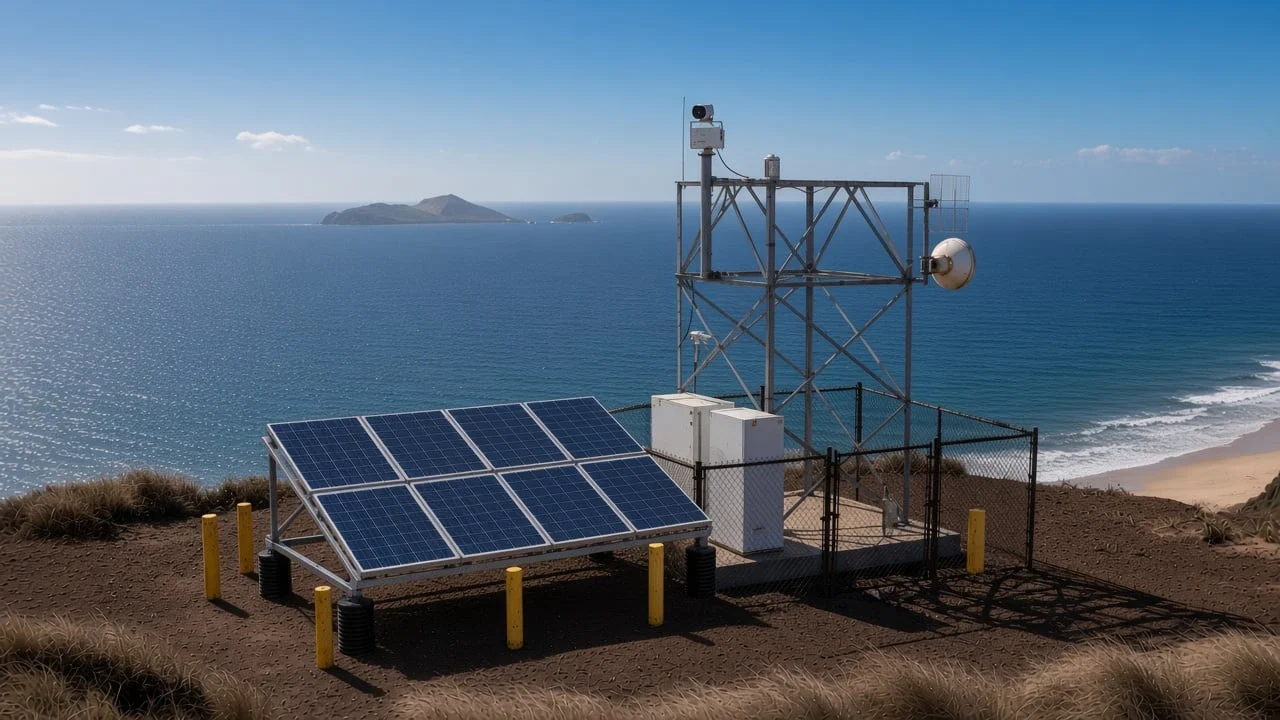
What we built
A self-contained solar power system that keeps a remote sensing package running 24/7/365 with no grid and no generator. The system pairs a solar array with a 48 V lithium battery bank and an outdoor power-electronics enclosure. It supplies steady 120 V AC power around the clock and holds about four days of reserve.
The load is small and it never stops. So the design focused on efficiency at low power, conservative sizing, and parts that can run unattended for years.
How it works
Solar array → combiner → charge controller → 48 V battery bank → inverter → 120 V AC load
- Array: eight bifacial modules in two strings. Each string has its own breaker and surge protection.
- Charge control: a single MPPT charge controller matched to the array.
- Storage: a 48 V lithium bank with a battery monitor that tracks state of charge.
- Conversion: a compact pure-sine inverter sized for the load.
- Monitoring: charge state, solar yield, and faults can all be checked from one app.
- Enclosure: an outdoor aluminum cabinet with thermostat-controlled cooling.
Spec (per site)
| Element | Spec |
|---|---|
| Output | 120 V AC, 60 Hz pure sine, continuous |
| Load | ~90 W around the clock (~2.2 kWh/day) |
| Solar array | ~3.8 kW, 8 bifacial modules |
| Storage | ~10 kWh 48 V lithium |
| Autonomy | ~4 days with no sun |
| Daily solar yield | ~6–7× the daily load |
| Cooling | Thermostat-controlled, DC-powered fans |
Key design decisions
1. Strings matched to the controller.
Wiring all eight panels in series would push the array voltage far past what the charge controller can take. Two strings of four keep it inside the safe window, even on cold mornings. Each string can also be shut off on its own.
2. One right-sized controller and a small, efficient inverter.
On a load this small, the power an inverter uses just sitting idle matters more than its peak rating.
3. A large array and a modest battery.
The array makes several times what the load needs. Extra solar is the cheapest way to refill the battery after cloudy stretches. The battery bank was already on hand and covers about four days, so the solar side does most of the work.
4. Honest battery monitoring.
The battery and the power electronics don’t share a communication protocol. Rather than force a workaround, we added a dedicated battery monitor and set charging to the battery maker’s limits. The result is safe, predictable charging.
5. An enclosure built for fit and heat.
The original cabinet was too shallow for the batteries, so we moved to a deeper one. A sealed box in strong sun traps heat, so thermostat-controlled fans keep the batteries and electronics within their rated temperatures.
What we delivered
- System architecture and full spec for both sites
- Corrected stringing, power electronics, and enclosure selection
- Complete bill of materials, wiring diagram, and enclosure layout
- Yield and thermal analysis, commissioning steps, and a maintenance schedule