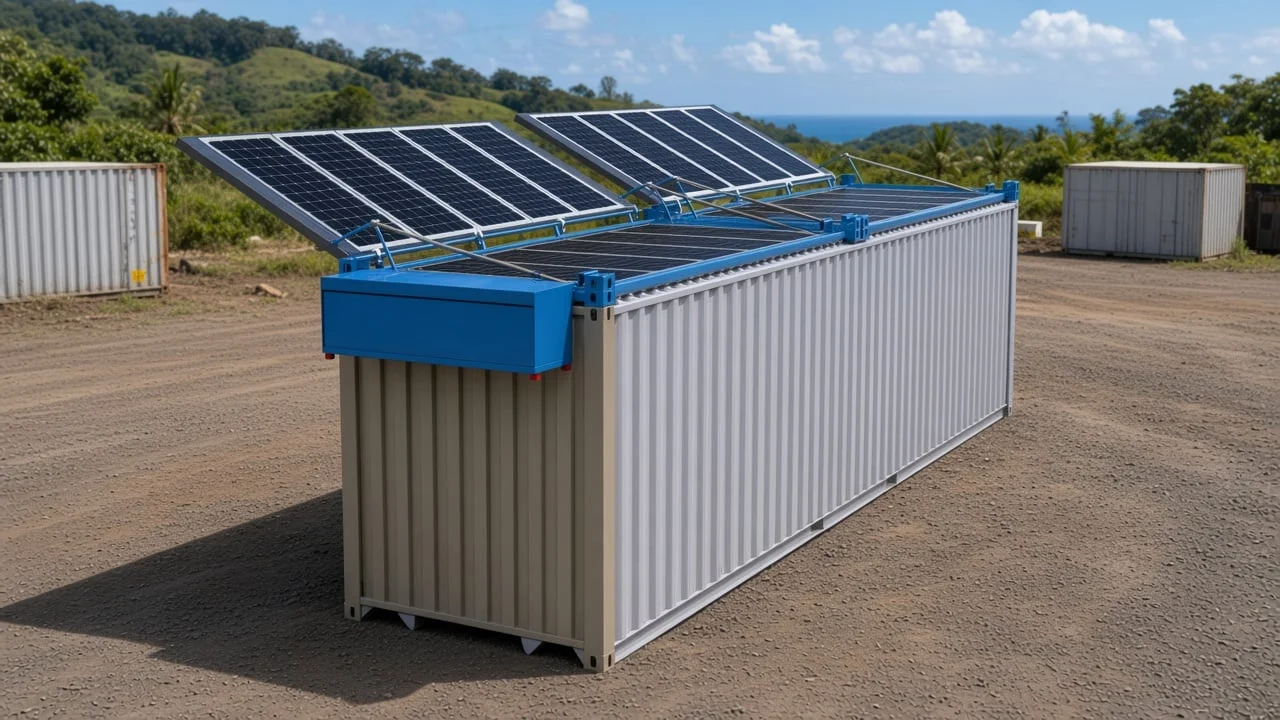
What we designed
A 20-ft containerized hybrid microgrid that powers one to four portable offices or workshops on 120/208 V three-phase. It runs on solar first and battery second. The generator starts only when it’s needed. Any one source can carry the full load by itself.
It’s built as a product, not a one-off install. It ships as a standard container, deploys fold-out solar arrays on site, and scales up by adding inverters, batteries, and arrays in parallel.
How it works
- Generation: tri-fold racks unfold panels off the container roof, roughly tripling the solar area.
- Power electronics: a parallel hybrid inverter/charger setup that supplies 120/208 V three-phase directly. It covers both 120 V office loads and 208 V air conditioning.
- Storage: modular lithium iron phosphate (LFP) batteries, split into redundant strings.
- Backup: an auto-start generator sized to each configuration.
- Control: an energy management system that uses solar → battery → generator, in that order, with on-site monitoring and alerts.
Spec
| Element | Spec |
|---|---|
| Output | 120/208 V three-phase |
| Platform capacity | Up to ~40 kW peak, expandable in parallel |
| Solar | ~7 kW per 20-ft tri-fold rack |
| Storage | Modular LFP, ~160–350 kWh depending on configuration |
| Autonomy target | 24 hours with no sun and no generator |
| Generator | 25–40 kVA, sized to each configuration |
| Redundancy | Full operation on any single source, with N+1 key components |
| Fuel savings | 60 to 90% reduction in diesel in a typical configuration |
Key design decisions
1. Solar first, generator as backup.
At a remote site, the cheapest kilowatt-hour is the one that doesn’t need diesel shipped in. In a typical configuration, solar cuts yearly fuel use from about 5,500 gallons to about 2,000.
2. Fold out solar racks.
The container roof alone covers only about a third of daily energy. Tri-fold racks roughly triple that on the same footprint, and they come off for shipping.
3. 24-hour battery as the baseline.
The baseline bank rides through a full day with no sun and no generator, which covers cloudy stretches and stowed arrays during storms.
4. LFP batteries, not lead-acid.
LFP gives more usable capacity, better efficiency, a much longer life, and less maintenance than the lead-acid bank. Its stable chemistry also makes it the safer choice.
5. Built for graceful degradation.
Every source can carry the load alone. A parallel hybrid power electronics means losing a panel, an inverter, or a battery string cuts capacity instead of shutting the system down. Each generator is sized to its configuration’s load rather than oversized, so it doesn’t burn fuel on capacity it never uses.
What we delivered
- System architecture and redundancy approach
- Three modeled deployment configurations with load, solar, and fuel projections
- Component selection, battery endurance options, and generator sizing
- A corrected approach to the solar frame, batteries, and generator
- An environmental and operational risk register